

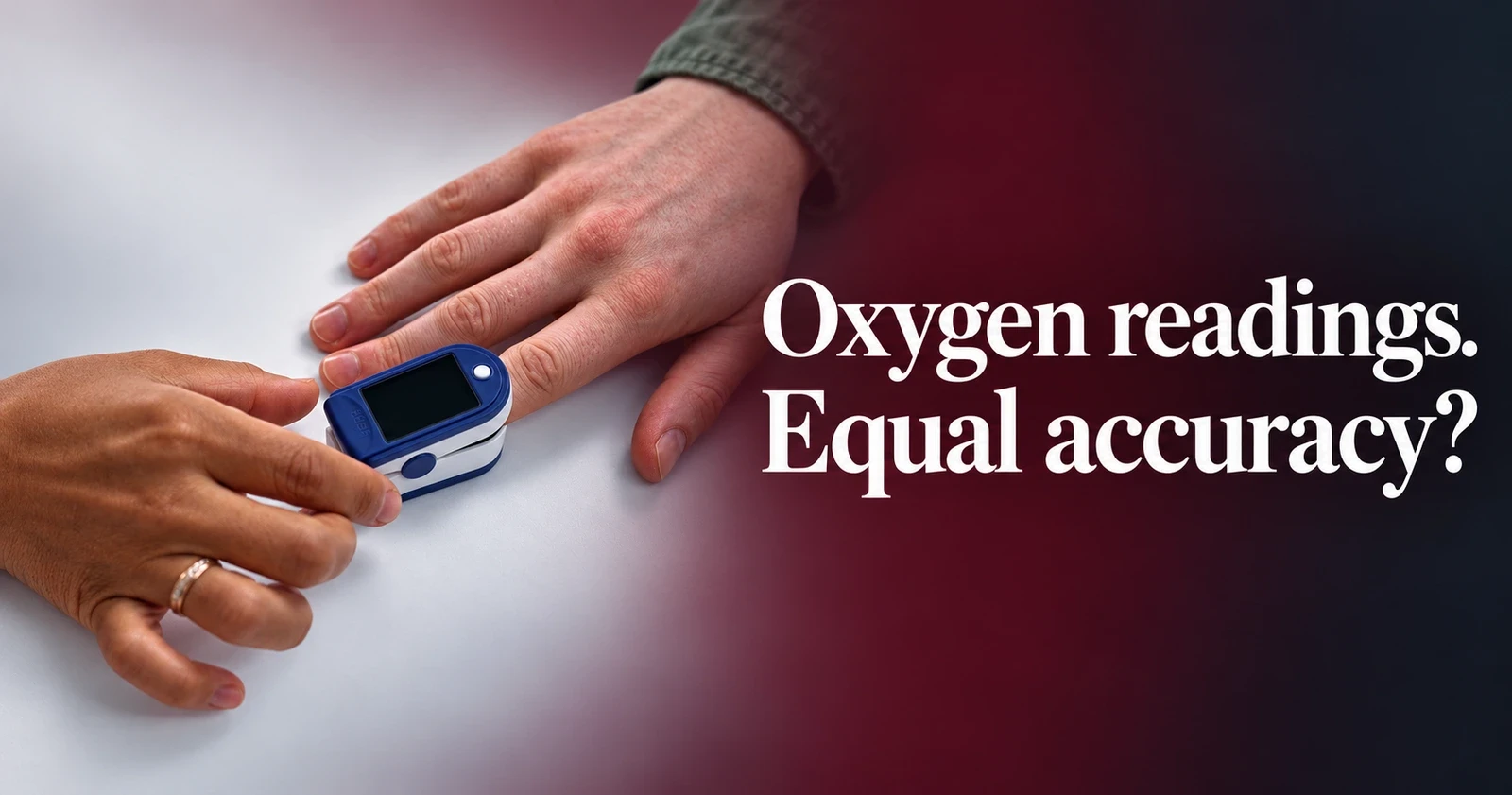
A pulse oximeter estimates blood-oxygen saturation using light. It does not directly analyse a blood sample, and its displayed percentage can be affected by skin pigmentation, circulation, movement and fit. A plausible-looking number can therefore carry uncertainty that is not obvious on the screen.
Skin tone matters because the concern is not simply occasional random error. UK and US regulators identify the possibility of overestimating oxygen saturation in people with darker skin pigmentation. That can make a reading appear more reassuring than the underlying oxygen level warrants.
What the clip is estimating
The FDA’s pulse-oximeter explanation describes a fingertip device that uses light to estimate oxygen saturation and pulse rate. The oxygen percentage and the pulse rate are different outputs; a stable pulse display does not by itself validate the oxygen estimate.
The signal must be interpreted by a device’s measuring system. Anything affecting the light signal or the blood flow at the measurement site can affect the result. The number is the output of that process, rather than a direct view of oxygen inside a blood vessel.
Skin pigmentation is one source of uncertainty
MHRA guidance for healthcare professionals identifies darker skin pigmentation as a factor that may cause oxygen saturation to be overestimated. It also lists movement, low perfusion, probe positioning, nail coatings and ambient light among possible influences.
These factors should not be collapsed into a single explanation for every surprising reading. They can affect different people, devices and conditions differently. Recognising an average concern about pigmentation does not establish the direction or size of an error in an individual reading.
It also does not provide a correction formula. Adding or subtracting a fixed number based on someone’s skin colour would imply a precision that this guidance does not supply.
What an accuracy claim needs to describe
For a reader looking behind an advertised accuracy figure, useful evidence would identify the exact device, the reference measurement, the range of oxygen levels studied and the people included. An overall average cannot establish equally close agreement for every person or skin tone.
Testing under controlled conditions also answers a different question from performance during movement or poor circulation. Neither a neat display nor repeated similar readings can independently settle whether an estimate is close to the reference value.
This guide does not rank current models or compare numerical errors between them. That would require model-specific original study methods and results, rather than extending one device’s evidence to the whole category.
Why regulators are concerned about the evidence
The FDA’s public overview describes efforts to improve performance evaluation across skin pigmentations, including its January 2025 draft guidance for medical-purpose pulse oximeters. The page identifies that document as a draft; this is not evidence that every existing device has subsequently been retested under a new final standard.
The US process is separate from UK device regulation. Neither a policy proposal nor a conformity mark should be read as a promise that an oximeter is equally accurate for every user in every circumstance.
A reading belongs within the care context
The MHRA describes oxygen saturation as one part of clinical assessment. Its home-use guidance concerns people advised and supported by a clinician, rather than a stand-alone consumer screening programme.
The FDA likewise cautions against relying only on the device and directs people with serious or worsening symptoms to a healthcare provider. A reassuring display should not be treated as proof that symptoms are unimportant. An individual’s monitoring plan and clinical advice remain separate from this explanation of the measurement.
The distinction also matters when reading hospital-at-home research: successfully transmitting a recorded oxygen value establishes data availability. It does not, on its own, establish the accuracy of that value or better patient outcomes.