

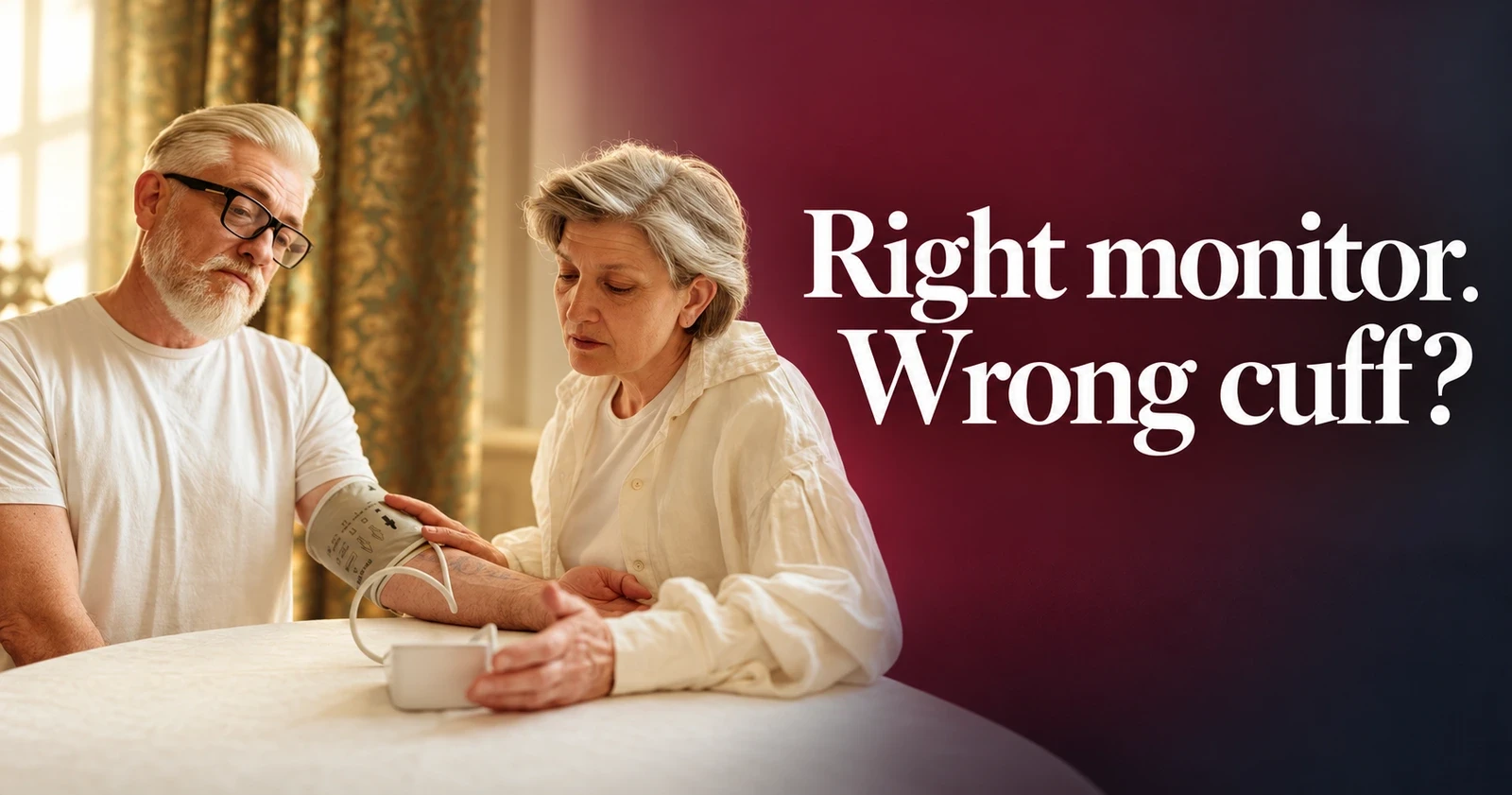
A home blood-pressure monitor’s validation and the fit of its cuff answer two different questions. Validation examines the measuring system under a defined protocol. Cuff fit determines whether the equipment is being used within its intended arm-size range. A reputable model can still give a misleading reading with the wrong cuff.
For someone comparing monitors or trying to understand a surprising result, the exact model and cuff combination matter more than the brand name or the number of features in its app.
What a validation listing establishes
STRIDE BP’s published listing principles describe how the organisation reviews validation evidence. Its listings distinguish devices assessed through validation studies from models accepted as having equivalent measurement functions or being identical to an already accepted device.
Those categories are useful because a product can have different names in different markets, while a familiar product family can contain materially different measuring systems. A listing should be checked against the actual model, rather than extended to everything sold by that manufacturer.
“Preferred” also has a specific meaning in this registry. For home monitors, STRIDE BP adds criteria including an upper-arm cuff, qualifying recent validation evidence and automatic storage or transfer of readings. It is not simply another word for “validated”, and neither label is a government product approval.
Why cuff size can change the number
The Cuff(SZ) randomized crossover trial, published online in August 2023, studied 195 adults in Baltimore. Participants had repeated automated measurements with cuffs that were appropriate, too small or too large, with the order randomized for the initial sets.
Using a regular-size cuff for everyone produced lower systolic readings among people who required a small cuff, but higher readings among people who required large or extra-large cuffs. The point is not that every mismatched cuff creates the same error. It is that a convenient standard size can systematically distort the measurement.
These were controlled measurements in a particular study, not a formula for repairing a home result. The reported group differences cannot tell an individual how much to add to or subtract from their reading.
Three checks behind a device description
These are checks on the equipment’s documented claims, rather than a ranking of current products:
| Check | What it helps establish | What it does not establish |
|---|---|---|
| Exact model and listing category | Whether the named measuring system is covered by the registry entry | That every model from the brand has the same evidence |
| Cuff’s stated arm-circumference range | Whether the supplied cuff is intended for the measured arm size | That every replacement cuff is interchangeable |
| Validation population and setting | Who and what the evidence concerns, where specified | Identical performance in every population or under every home condition |
STRIDE BP’s criteria specifically examine device and cuff differences when assessing equivalent models. A new cuff shape or size is not automatically a cosmetic change. Its registry review can also involve manufacturer submissions and fees; a listing is an evidence-review process, not a guarantee of an error-free reading in every person.
Home technique remains a separate part of the process
NHS Mid and South Essex’s home-monitoring guidance places a validated monitor alongside correct technique. That is a local service explanation, not evidence that the same programme is available everywhere.
A validation listing cannot establish whether a particular home reading was taken under appropriate conditions. Equally, a careful measurement routine cannot supply validation evidence missing from a device. The two kinds of assurance complement each other.
This also explains the gap between cuff readings and Apple Watch hypertension notifications. A notification identifies a pattern using the watch’s documented feature; it does not provide the numerical pressure measurement supplied by a cuff monitor.
Bluetooth, memory and an attractive chart can make records easier to share. They do not remove the need to identify the measuring system, its cuff and the evidence behind the result.