

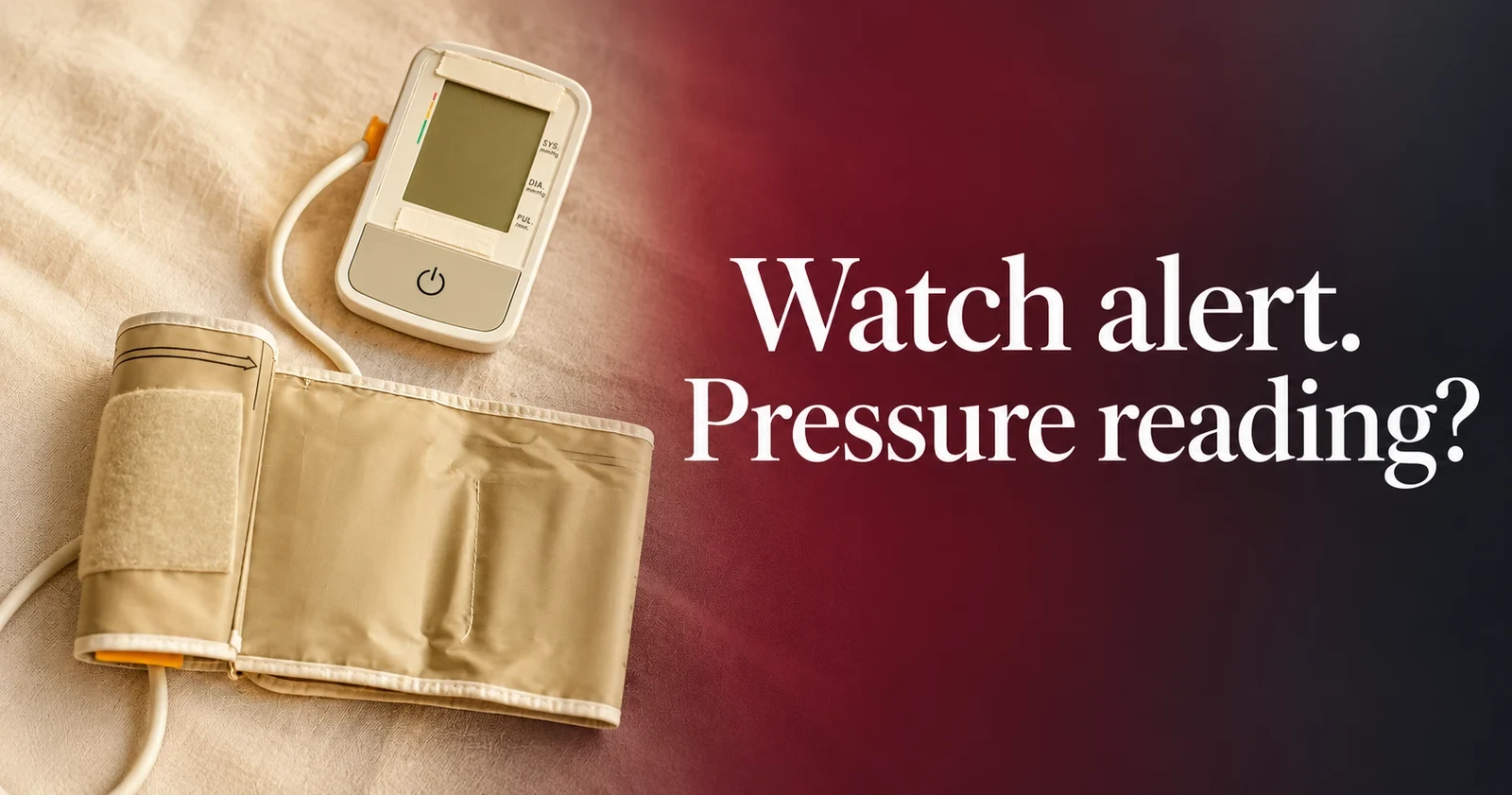
Apple’s hypertension notification feature does not give you a numerical blood-pressure reading. It looks for patterns associated with possible high blood pressure and can send an alert. The FDA’s original feature record describes a notification as the output, rather than the two numbers produced by a cuff measurement.
That distinction answers the question behind many searches for “Apple Watch blood pressure”. A device can flag a reason for further checking without measuring the value a person expects to see.
What the watch is looking for
Apple says the feature analyses information from the watch’s optical heart sensor over 30-day periods, beginning when notifications are enabled. It is a background assessment of patterns, rather than a button that takes an immediate pressure reading. Apple’s explanation
The regulatory description identifies the input as photoplethysmography, or PPG: an optical signal collected by the watch. Software evaluates qualifying signals and aggregates the results to identify possible hypertension. The intended use excludes diagnosing hypertension, tracking treatment effects and blood-pressure surveillance. FDA device description and indications
A notification, a reading and a diagnosis answer different questions
The comparison below concerns outputs and their documented purpose. It does not rank devices or assess an individual’s results.
| Information | What it tells you |
|---|---|
| Watch hypertension notification | The feature has identified a pattern associated with possible hypertension. It does not supply a pressure reading. |
| Cuff measurement | A blood-pressure result expressed as two numbers, taken at a particular time. |
| Confirmed diagnosis | A clinical conclusion that may involve further home, surgery or 24-hour measurements. |
Sources: FDA feature record, NHS explanation of blood-pressure checks.
The NHS describes a check as inflating a cuff around the upper arm and measuring pressure in the blood vessels. If a result suggests high blood pressure, further measurements may be needed to confirm it. An alert and a diagnosis therefore occupy different stages of the process. NHS guidance
Why silence does not mean a normal result
The FDA’s indications explicitly state that the absence of a notification does not establish the absence of hypertension. The device description also says an alert will not appear when insufficient data has been collected. There is no numerical “normal” result hidden behind an empty notification history. FDA indications and description
Apple’s published follow-up instructions connect an alert to a separate cuff: users are prompted to set up a seven-day Blood Pressure Log and discuss the notification and measurements with their healthcare professional. Those measurements come from the cuff, not from the notification feature. Apple’s notification guidance
Which watches and users are covered?
Apple’s current support page lists Series 9 or later and Ultra 2 or later, with current software, but adds a specific caveat: Series 12 and Ultra 4 may still await additional clearance in some regions. Apple Watch SE is excluded. Apple also specifies a compatible iPhone, enabled Wrist Detection, and users aged 22 or older who are not pregnant and have no previous hypertension diagnosis. Current requirements
Apple’s country availability directory lists the UK and Ireland for hypertension notifications. That country listing should be read alongside the model restrictions, rather than treated as proof that every newly released watch supports the feature there.
What the feature documentation establishes
The useful distinction is between detecting a pattern and measuring pressure. The FDA record describes the submitted software; Apple’s support information describes its current use and availability; NHS guidance explains the separate measurement process. Together they explain the feature without turning it into a universal blood-pressure monitor.
These documents also answer a different question from whether wearing a watch improves long-term health. A documented notification function does not, by itself, establish that outcome.