

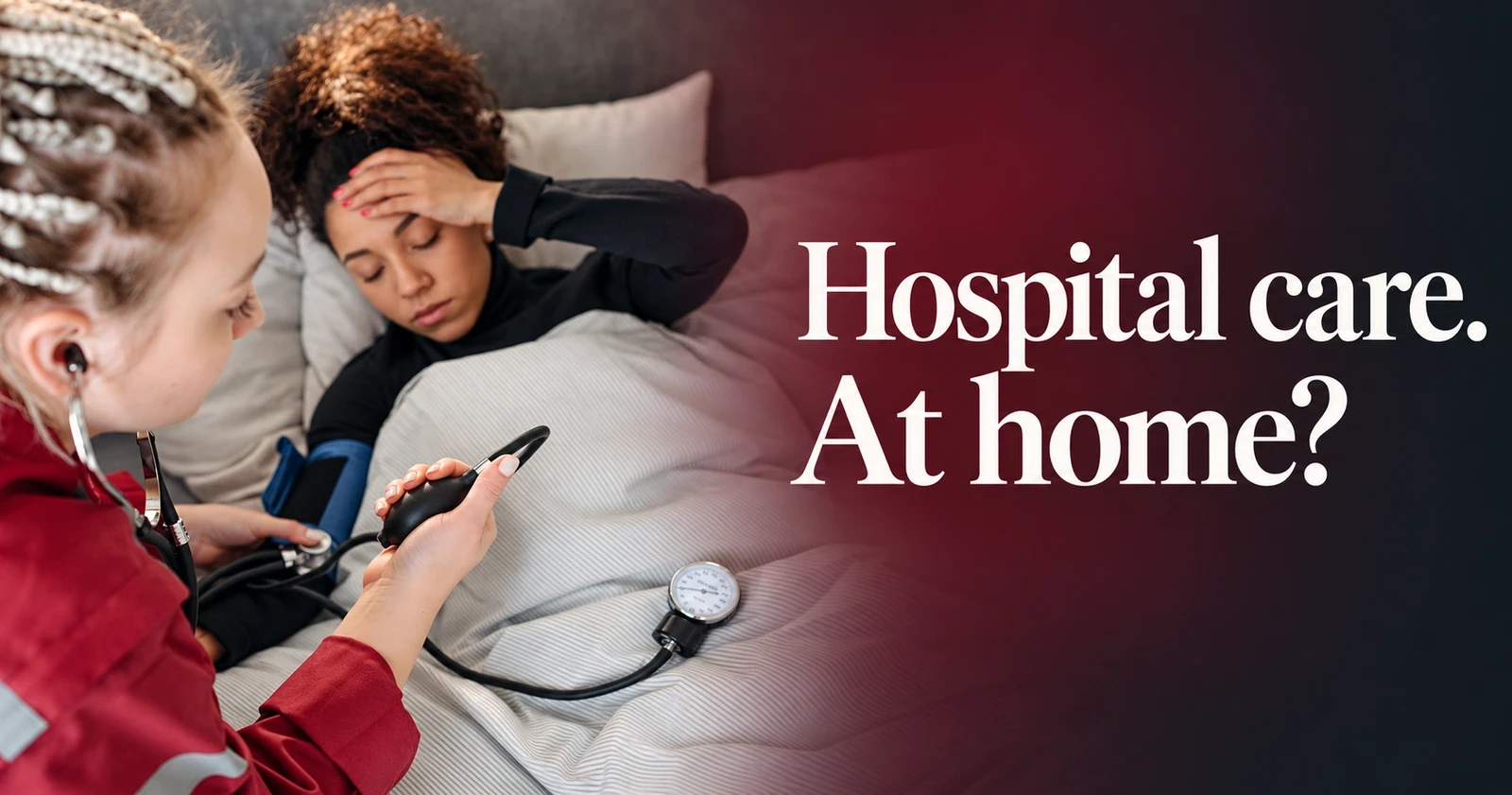
Oxford’s wearable-patch study showed that remote vital-sign monitoring was feasible in a small hospital-at-home service. It did not establish that the system improves patient outcomes. The original nonrandomized paper was published on 25 September 2026; Oxford highlighted it on 13 October. Original study and Oxford announcement
For teams assessing home monitoring, the useful finding concerns whether readings became available to clinicians—not simply whether a sensor existed.
The patch sat within an acute-care service
Oxford University Hospitals describes its Hospital at Home service as treatment for acutely unwell patients that can avoid or shorten a hospital stay. It includes clinical review and treatment at home, with referrals through healthcare providers. The service’s description
The announced study involved 26 monitored adults. A VitalPatch chest sensor collected heart and breathing rates automatically for up to seven days. Additional oxygen, blood-pressure and temperature measurements required equipment use or recording by patients or carers. Study workflow
This is a clinical service with a monitoring workflow, rather than a demonstration that buying a wearable creates hospital care at home.
What the percentages actually count
The real-time data analysis excluded one participant monitored for less than four hours. Across the remaining 25 participants, the paper examined 674 four-hour windows. Results and Table 2
| Vital sign | Four-hour windows with a real-time reading |
|---|---|
| Heart rate | 600 of 674 (89.0%) |
| Breathing rate | 508 of 674 (75.4%) |
These are proportions of time windows, not percentages of patients or measures of accuracy. Data recovered later after reconnection are excluded from these real-time figures. What the denominator means
Oxford’s announcement emphasizes the potential value of passive collection, particularly where repeated patient or carer measurements are burdensome. Its reported contrast with active recording is a feasibility observation; it does not make the different measurements a randomized device contest. Passive-monitoring interpretation
Accuracy, availability and outcomes need different evidence
A separate 2021 study tested VitalPatch readings against reference measurements during movements and controlled hypoxia in healthy volunteers. Heart-rate estimates met its prespecified criteria; breathing-rate estimates did not meet them during two movement tasks. That controlled validation asks about measurement accuracy, rather than dependable data delivery in acutely unwell people’s homes. Earlier validation methods and results
Some researchers overlap between the studies, so this is not an independent replication of the home trial.
For this Oxford service, the new paper supplies a practical view of data availability. Its small, single-service, nonrandomized design cannot establish whether the monitoring causes safer care or fewer admissions. Several authors helped develop the monitoring system. Study limits and interests
When assessing another home-monitoring proposal, these findings suggest keeping three questions separate: how well the device measures, how reliably readings reach the team, and what changes for patients. Evidence for one does not automatically answer the others.