

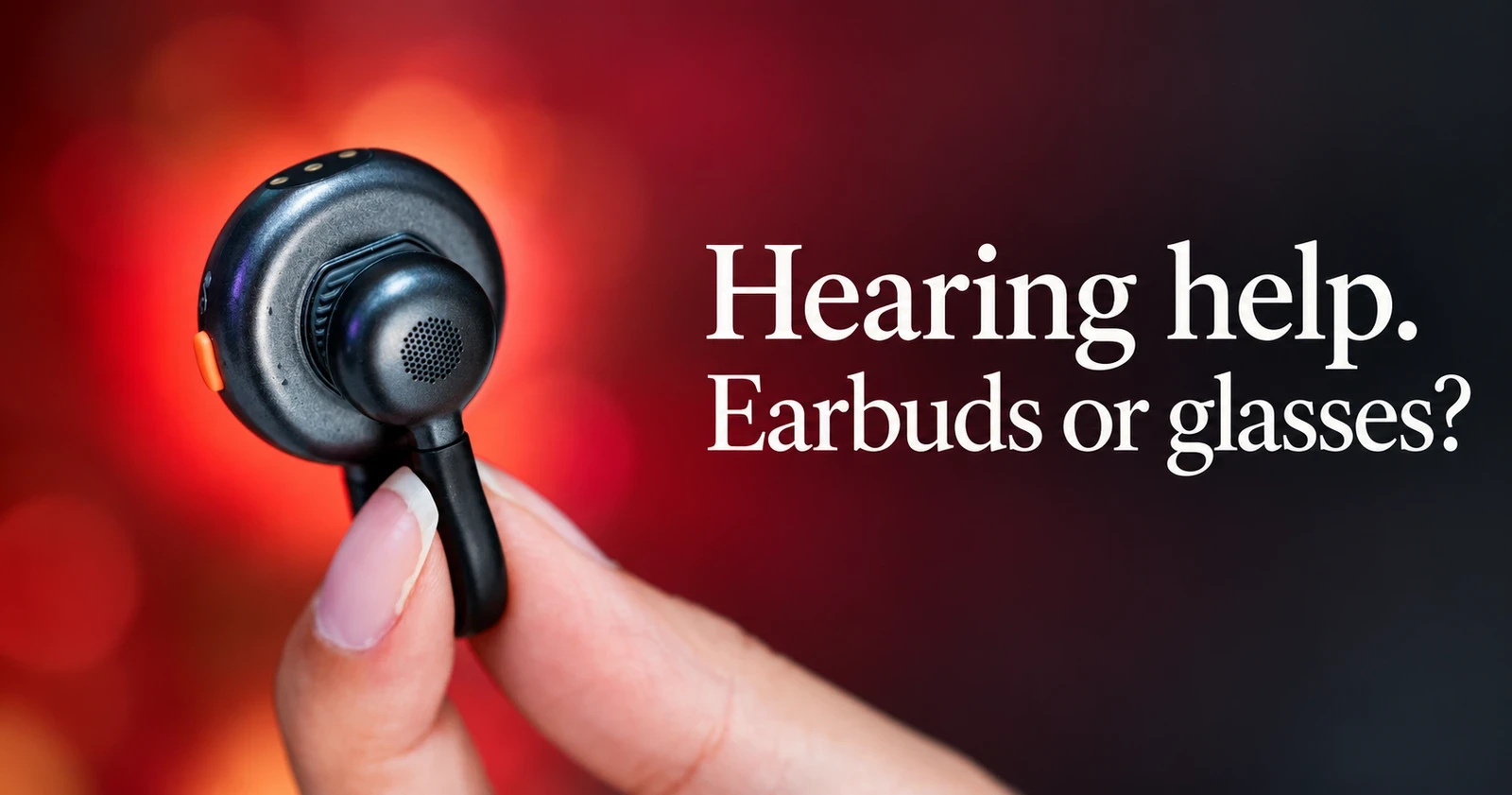
Hearing aids in earbuds and glasses can both amplify sound, but their sound delivery and fitting methods differ. The original Nuance FDA record describes speakers in the glasses’ arms directing sound towards an open ear canal; the AirPods Pro 2 system it compares with delivers sound through an ear tip.
The familiar shape is only the first difference. Software, fitting and the scope of the evidence matter too.
Two documented approaches to hearing amplification
This selected comparison uses AirPods’ current support guidance and the original Nuance Audio regulatory record. It describes design, not which device is best for a particular person. The Nuance column concerns the original system, not every newer glasses generation.
| Attribute | AirPods Hearing Aid feature | Original Nuance Audio system |
|---|---|---|
| Sound delivery | Earbud with an ear tip; the original regulatory comparison names AirPods Pro 2. | Frame-mounted microphones and speakers; the ear canal remains open. |
| Starting fitting information | An AirPods Hearing Test result or an audiogram from a hearing professional. | User selects among four preset profiles; an individual’s hearing-test result is not used for fitting. |
| Documented intended users | Adults aged 18 or older with perceived mild to moderate hearing loss. | Adults aged 18 or older with perceived mild to moderate hearing loss. |
Sources: Apple’s current fitting guidance, Nuance’s original FDA description and comparison.
These approaches answer different setup questions: one starts with an individual’s test result; the other asks the user to choose a preset. That distinction is supported by the documentation. It does not, on its own, prove a difference in clinical benefit.
Hearing Aid and Media Assist are separate features
Apple currently documents Hearing Aid support for AirPods Pro 2 and Pro 3, with compatible devices and current software. Its Hearing Aid feature amplifies environmental sound in Transparency mode. Media Assist applies hearing-related adjustments to music, video and calls across noise-control modes. The two names describe different functions. Apple’s feature explanation
Apple’s feature availability directory currently includes the UK and Ireland for Hearing Aid. It gives separate lists for Hearing Test and other features; a product’s presence in a shop does not establish availability of every software function.
Why the generation matters
Nuance’s current UK page distinguishes the original Nuance Audio Glasses from Nuance Audio Plus. For example, it advertises iPhone Bluetooth calling for Plus and lists that function as unavailable on the original glasses. These are the manufacturer’s stated features, not results of a comparative listening test. Nuance’s generation comparison
The older FDA record describes a particular software and hardware arrangement. It cannot silently be treated as evidence for all features or outcomes of a newer generation. The same distinction applies when a current support page includes a newer AirPods model than the original authorization study.
What the original study actually compared
The FDA’s September 2024 AirPods announcement describes a study of 118 people with perceived mild to moderate hearing loss. It reports similar perceived benefit from self-fitting and professional fitting of the same device. The original authorization concerned the Hearing Aid Feature used with AirPods Pro 2. FDA authorization announcement
That comparison is narrower than “earbuds work as well as any hearing aid”. It does not compare AirPods with Nuance glasses, establish a winner across the market or directly test every later hardware version.
Hardware is only part of a hearing-device comparison
A 2025 JAMA Otolaryngology trial compared service models using different behind-the-ear hearing devices, including prescription models adapted to simulate preset-based over-the-counter fitting. Its methods examined differing levels of audiologist support; its limitations note that only one preset-based OTC device was simulated. It was not an AirPods-versus-glasses trial. Original trial methods and limitations
The study gives a reason to keep support and fitting visible when describing hearing technology. Its findings cannot supply the missing head-to-head comparison between the products here.
For a clearer comparison, keep four details together: the exact generation, the sound-delivery design, the fitting method and what the supporting study tested. Familiar hardware can carry a hearing function; it does not make those four details interchangeable.