

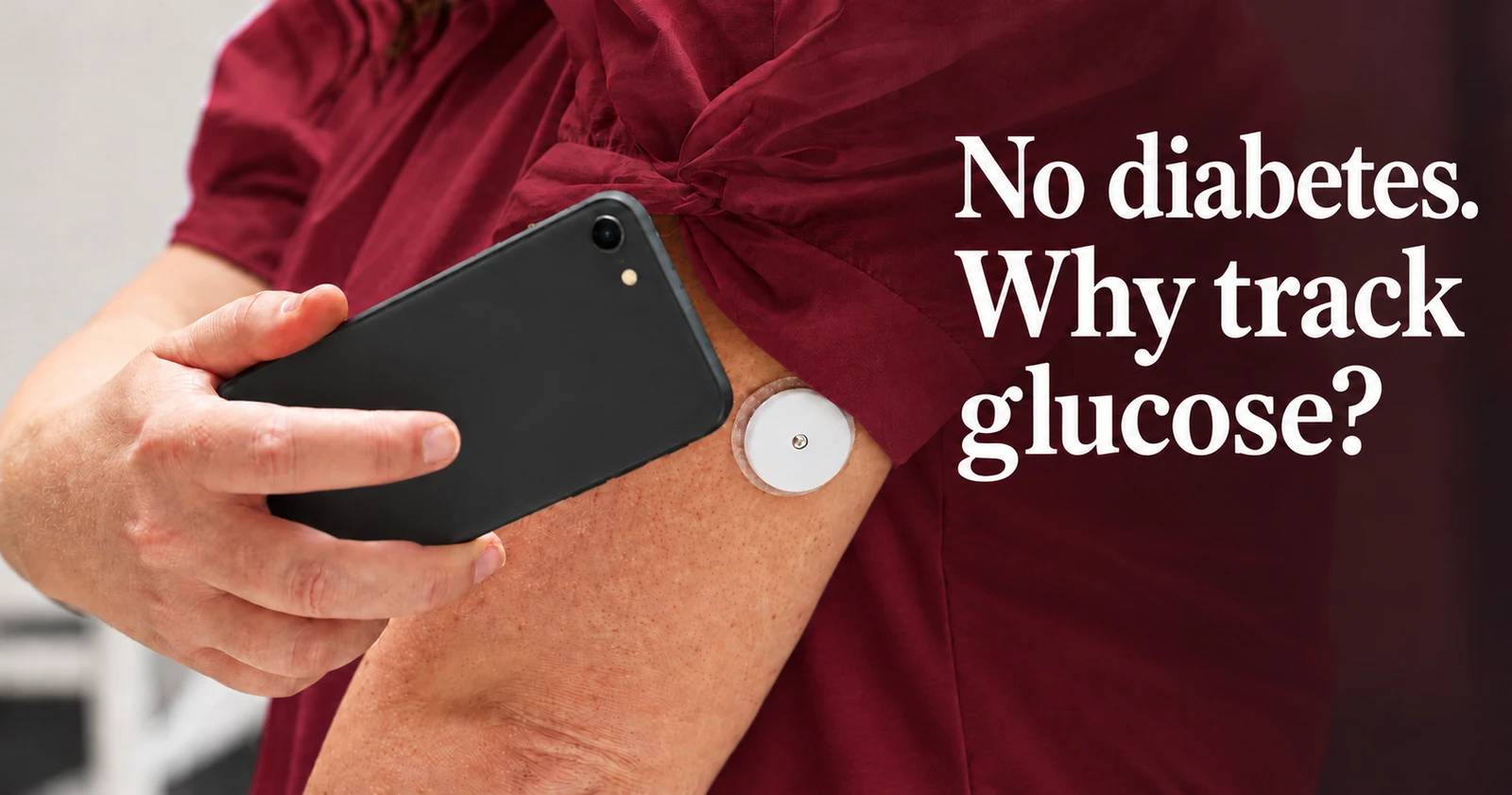
For someone without diabetes, a continuous glucose monitor can show glucose patterns, but that does not establish that wearing one improves health or prevents diabetes. An August 2026 JAMA patient page says good evidence for those benefits is lacking. It also cautions that the meaning of fluctuations in people without diabetes remains uncertain. JAMA’s explanation
The useful question is what a particular reading—and the evidence behind it—can actually support.
What the sensor measures
A continuous glucose monitor, or CGM, uses a sensor under the skin to measure glucose in the fluid between cells. It produces a series of readings rather than a single snapshot. A January 2026 systematic review describes this measurement principle and examines uses in people without diabetes. How CGM works
A trace can make a pattern visible. Interpreting that pattern as a reason to change food choices requires another step. The JAMA authors warn that trying to eliminate spikes can lead people to restrict healthy foods unnecessarily, including fruit. A flatter line is therefore not, by itself, a measure of a better diet. Interpreting fluctuations
Why “without diabetes” is too broad a category
The January review included 23 studies involving 1,074 participants, with different designs and interventions. It reported lower mean glucose in its pooled analysis, but no significant pooled change in body mass index. Its subgroup discussion distinguished people with prediabetes from healthy participants with normal glucose levels. Review results and subgroup analysis
These distinctions matter. A result from a structured programme for people with prediabetes does not establish the same benefit for a healthy person buying a sensor independently. A change in mean glucose also answers a different question from whether diabetes is prevented or long-term health improves.
That is why the review’s favourable findings and JAMA’s caution need not be contradictory: their populations, outcomes and questions are not interchangeable.
A glucose number on a watch may come from elsewhere
The FDA’s February 2024 US safety notice distinguishes a watch that claims to measure glucose without piercing the skin from an app displaying readings supplied by a separate, skin-piercing sensor. The notice concerns independent watch and ring measurement claims; it does not treat those displays as the same technology. FDA’s measurement-versus-display distinction
Seeing a glucose number on a wrist therefore does not tell you where it was measured. This US notice also does not establish the regulatory status of an individual UK product.
More readings can bring a burden
JAMA describes skin irritation, equipment problems and excessive focus on numbers among potential downsides. Frequent alerts can cause stress or interrupt sleep, although it notes that over-the-counter systems typically lack built-in alerts. Potential burdens
For understanding a CGM claim, three questions help keep the evidence in view: who was studied, what changed, and whether that change was a health outcome or a sensor reading. None requires treating every rise as something to eliminate.
The distinction between a device’s observation and a clinical conclusion also appears in our guide to Apple Watch blood-pressure notifications.