

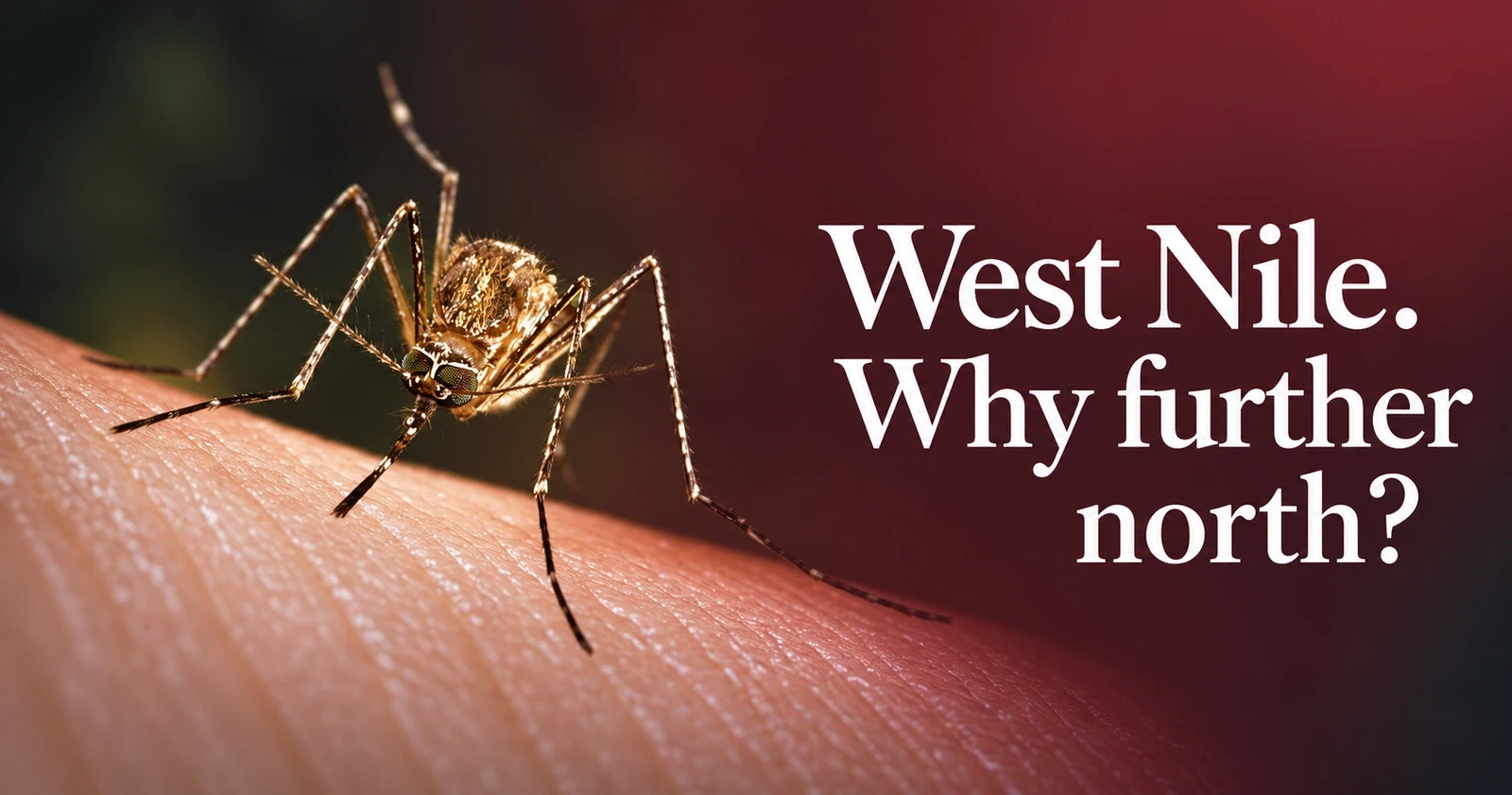
West Nile virus activity has extended further into northern Europe during a season that the joint ECDC–EFSA report describes as the most geographically widespread on record. The agencies say the broader spread does not, by itself, indicate more severe disease in humans.
The October report, released on 15 October using data submitted up to 7 October 2026, is a regional surveillance snapshot. Newer national updates need to keep their own dates rather than being folded into its totals.
Two totals, with different coverage
The joint report records 1,715 locally acquired human cases in 13 EU/EEA countries. It separately records 140 cases in five EU candidate countries. Together those make 1,855 reported cases across the wider set of reporting countries, not 1,855 in the EU/EEA.
The report identifies expanded activity in Belgium and the Netherlands, including Belgium’s first reported human infections. It also records new affected regions elsewhere. Its analysis combines human and animal surveillance, while preserving the different reporting systems.
The counts are provisional. The report says activity had declined from the August–September peak, although further notifications could still arrive. This describes the reporting position at its cutoff, rather than a prediction that transmission has ended.
Country totals describe detected and notified cases. The agencies caution that surveillance intensity, diagnostic practices and reporting delays affect the picture, and that most human infections are asymptomatic or subclinical. Reported cases are therefore only part of the infections occurring.
A national update can move ahead of the European snapshot
The Dutch public-health institute RIVM’s 15 October update reports 64 human cases, five more than its previous update. The earlier count of 59 appears in the joint European report.
That difference illustrates a reporting cutoff, rather than evidence that the sources should be made to agree by replacing one number. A reader comparing them needs the date attached to each observation.
RIVM describes collaboration between human-health, veterinary, virology, epidemiology and ecology specialists. Its update draws on several kinds of surveillance, including diagnostics and research. These streams help build a picture of circulation, but they are not interchangeable counts of the same event.
Wider spread is not a severity estimate
The geographical finding concerns where activity has been detected. Disease severity concerns what happens to infected people. Individual risk adds further questions about exposure and the person concerned. A regional case total cannot answer all three.
Similarly, a higher detected count in one country does not by itself demonstrate that it is more dangerous than another. Different testing and reporting arrangements can change which infections become visible. Comparing crude totals as a country-safety ranking would conceal those differences.
For health systems, the report’s value is the changing surveillance picture: activity in additional areas, evidence arriving through several reporting streams, and the need to keep dates and definitions attached to the numbers. It supports a broader geographic account of the 2026 season, without turning that account into a claim of increased severity or an individual travel-risk score.