

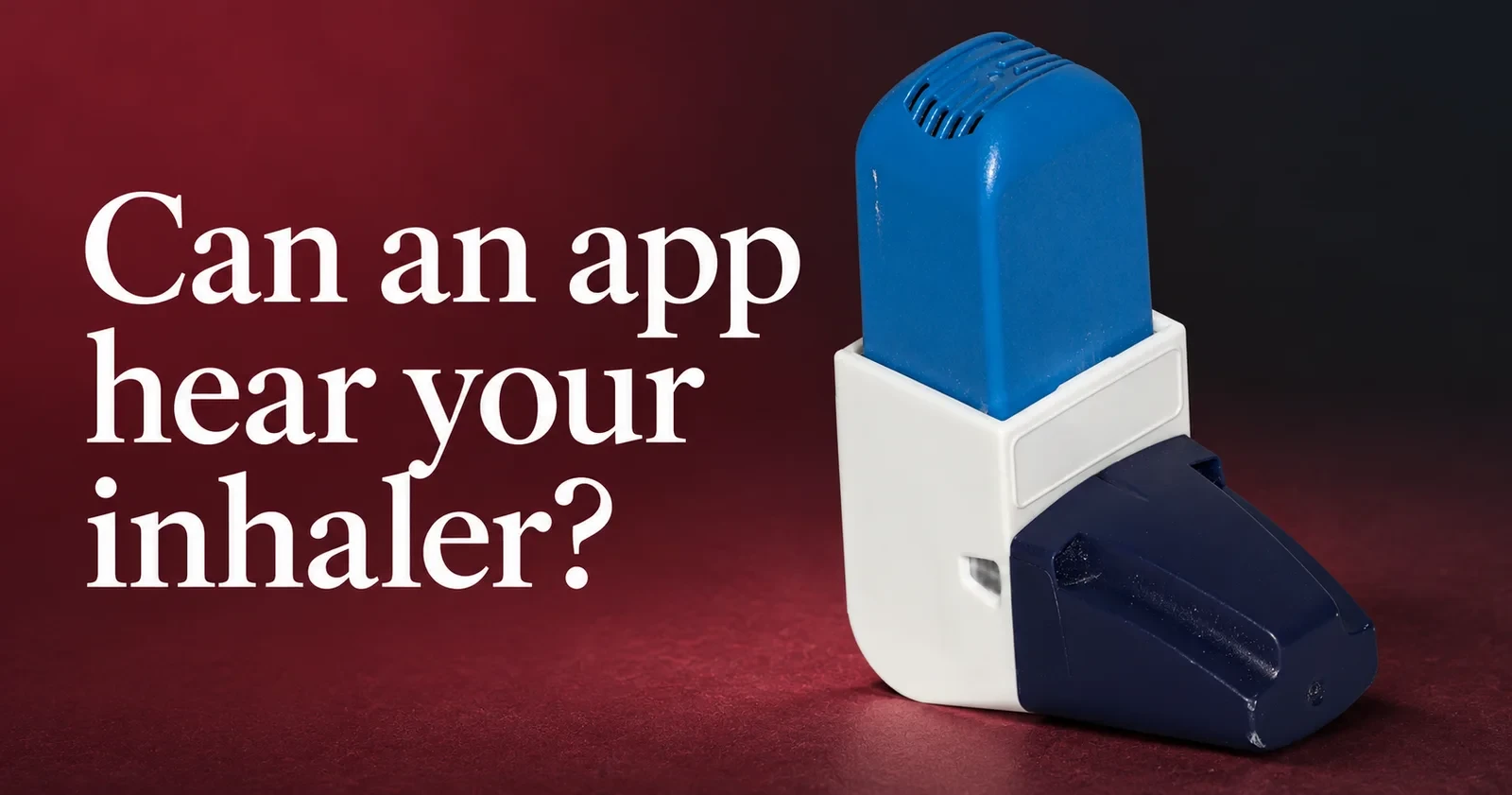

A smart inhaler can aim to record when a device is used, or to assess something about the inhalation itself. Those are different measurement tasks. A University of Copenhagen development project with Sonohaler explored sound-based feedback from a dry-powder inhaler; that does not establish how much medicine reached the lungs or whether users experienced better health outcomes. Development account
The useful question behind a “smart” label is therefore what the system actually senses and what evidence connects that signal to its intended purpose. Our prescription companion-app guide explains the FDA’s hypothetical connected-inhaler example; the development project here is a separate real device and evidence question.
What the sound project was developing
In its December 2025 account, the university described collaboration between formulation researchers, Sonohaler’s data scientists and design engineers. The work combined a capsule-based dry-powder inhaler with algorithms intended to interpret sound and supply feedback through an app.
The account says a patent had been filed and CE marking was still needed before marketing. That is the development status described at that time, not confirmation of current availability, authorisation or performance. A patent filing also does not supply clinical validation. Project and dated status
It is helpful to separate the intended chain: a physical action produces a signal, software interprets that signal, and feedback is presented to a user. Evidence about one link does not automatically establish the next. Recording an event, estimating technique and demonstrating a patient benefit require different comparisons.
Patients may want support at particular times
A separate qualitative study interviewed 11 people with cystic fibrosis from four European countries about electronic inhalation-monitoring devices. Participants described limited value for continuous digital monitoring, differing interest in such systems and potential usefulness during particular periods, such as starting a new inhaled treatment or device. Non-app support was preferred. Study abstract
These interviews describe experiences and preferences. They do not validate the Sonohaler prototype, establish how common those preferences are among all patients, or show whether an app improves outcomes in asthma or another condition. Two authors were affiliated with Sonohaler; the paper reports no specific research grant and no declared competing interests.
Read the sensing claim before the feature list
For anyone trying to understand this technology, the evidence needs to identify the measured signal, the reference used to check it, the people and devices tested, and what the feedback is intended to change. The qualitative work adds a further question: whether the information is useful enough to fit into everyday treatment routines.
The sources support a development explanation and a small study of preferences. They do not support a product recommendation, instructions for changing inhaler technique, or a conclusion that sound monitoring delivers the prescribed dose.