

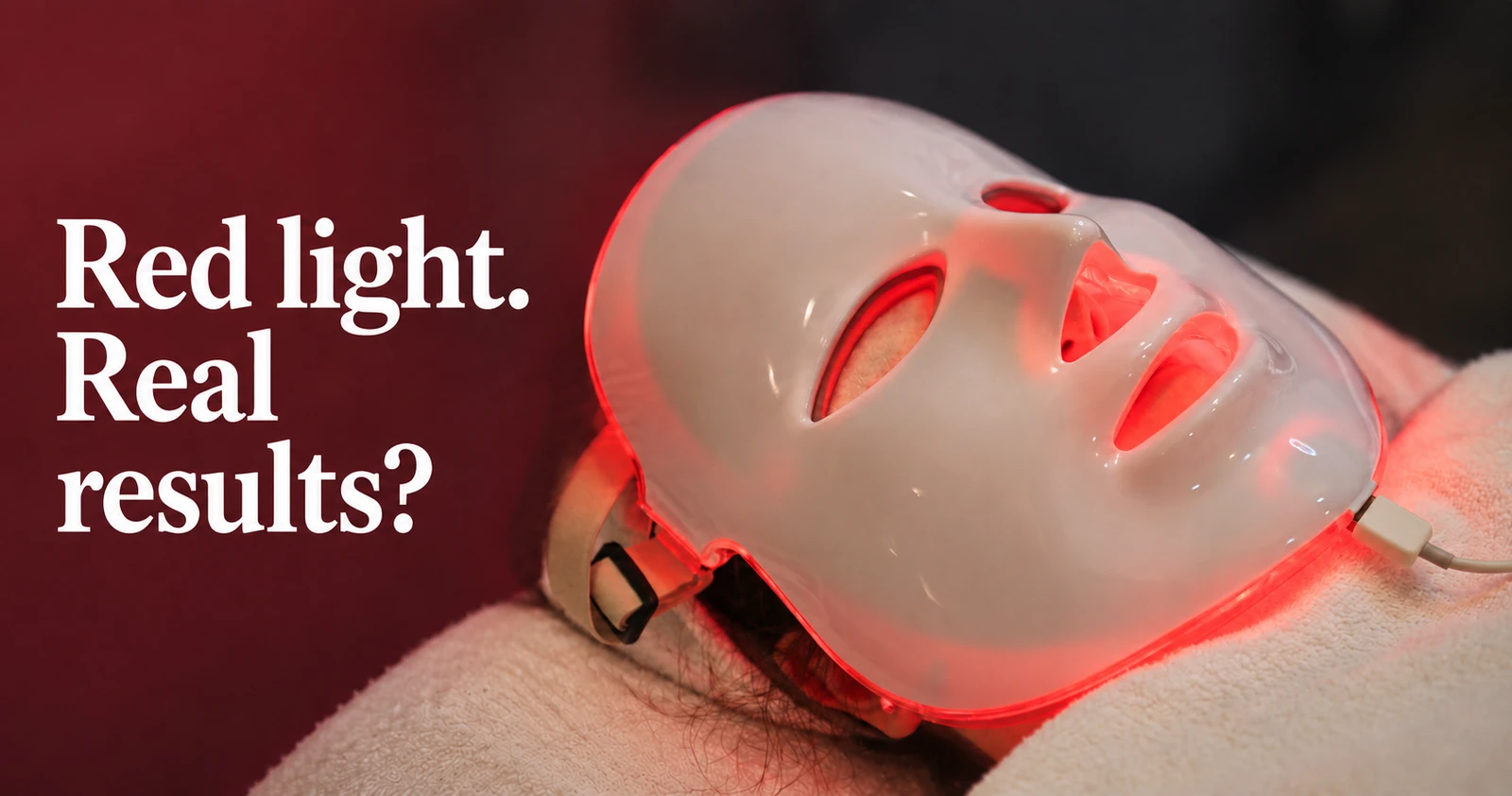
Some studies report benefits from light treatment, but “red light therapy works” is too broad a verdict for every home device and advertised use. The evidence depends on the condition studied, the light delivered and the outcome measured. A 2025 review of home LED acne treatments illustrates both the promise and the limits. Home-LED review
For someone looking at a mask, wand or panel, the useful distinction is between evidence for a particular treatment and evidence for the product in front of them.
One name covers different devices and treatments
The American Academy of Dermatology describes red-light therapy as treatment using red or near-infrared light, also called photobiomodulation. Home products include masks, panels and wands; other forms are sold for hair-related uses. AAD’s explanation
A shared label does not make these devices interchangeable. In Stanford Medicine’s account, dermatology experts explain that strength, wavelength, treatment duration and frequency all affect the intervention. Clinic treatments and home products can deliver different amounts of light. Stanford’s device context
Even a study with encouraging results cannot answer every question about a different product used in a different way.
What a home-LED acne review found
A 2025 systematic review in JAMA Dermatology included six randomised studies and 216 participants with mild-to-moderate acne. It examined portable or home devices using red light, blue light or both. The review reported greater improvement in acne measures with LED treatment than with the studies’ control conditions.
But those comparisons were not uniform. Devices, light settings, treatment periods and controls differed. The authors explicitly cautioned that the findings might not generalise to other products on the market. Review methods, study table and limitations
This is evidence about the interventions studied. It does not establish that every red-light mask produces the same result, nor that a combined red-and-blue treatment proves the effect of red light alone.
Broader research does not supply a universal verdict
A separate 2025 umbrella review examined 15 meta-analyses of photobiomodulation trials across multiple conditions. Using a modified evidence-grading framework, its authors rated certainty across 35 outcomes from very low to moderate; none reached high certainty. Its database search ended on 8 December 2023. Umbrella review methods and findings
Those results give context for the wider research field. They are not a current test of consumer masks and panels. Evidence from one condition, device or clinical protocol cannot simply be transferred to another advertised benefit.
The two reviews also answer different questions: the acne review focuses on portable/home LEDs, while the umbrella review covers a broader set of clinical uses. Combining their conclusions into a single success rate would obscure those differences.
Four details that make a device claim more informative
These are questions for reading evidence, not a product ranking or treatment plan:
- What was studied? A named device and defined settings are more specific than a general claim about red light.
- Who took part? A result in people with one diagnosed condition does not establish a benefit for everyone.
- What was the comparison? A sham device, no light and another treatment answer different questions.
- What changed, and for how long? A measured outcome over a study period is different from a promise of lasting improvement.
Together, these details help identify whether a cited study actually supports the claim being made, or only a narrower one.
Safety findings have limits too
The acne review reported no severe adverse reactions in its included studies, while some participants experienced irritation or discomfort. That observation is limited to those studies and their duration. Reported adverse effects
AAD’s guidance notes unanswered long-term questions and recommends discussing suitability with a dermatologist, particularly where light sensitivity, skin conditions or medication may matter. It also advises following the device’s specified eye-protection instructions. AAD’s precautions
The evidence supports a more precise question than whether red light is universally good or useless: what does this research establish about this use, with this device?