

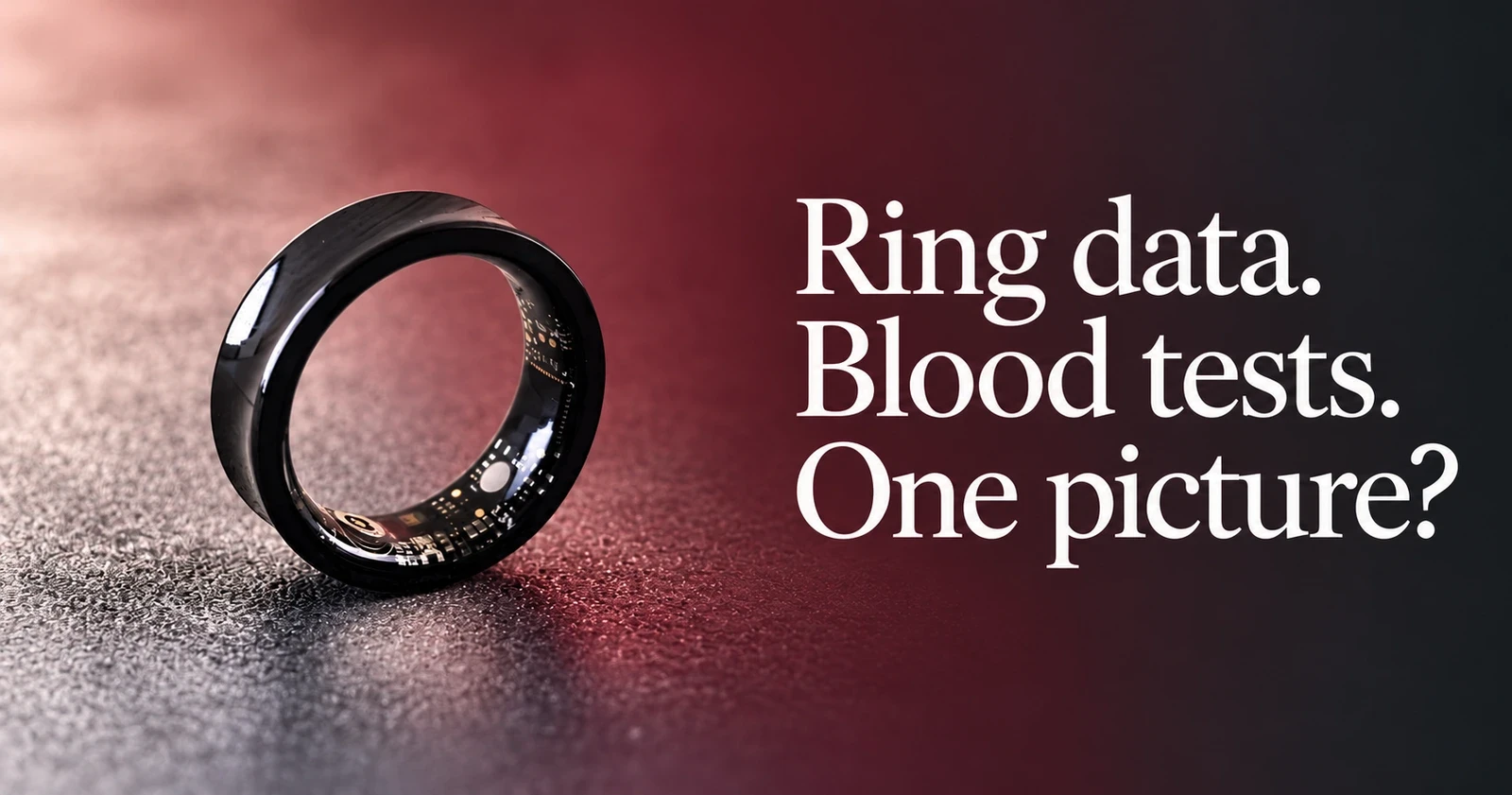
Oura Health Panels brings blood-test results into the same app as ring data. The ring does not collect the blood sample or perform the laboratory analysis. What changes is where external results are displayed and how the app presents them alongside wearable information.
That makes three separate questions worth keeping apart: where the result came from, whether the feature is available to the member, and what can reasonably be inferred from the combined display.
Ordering a test and uploading a report
According to Oura’s current Health Panels support page, members can use a US laboratory-booking service or upload an existing laboratory report as a PDF. As documented on 16 October 2026, uploading is available across supported countries, in English. Booking is US-only, excluding Arizona, New Jersey, New York, Rhode Island and US territories.
The documented feature requires a Gen3 or later ring, active membership and an adult user. These are service conditions, not evidence that a ring has acquired a new blood-sensing capability.
The support page names Quest Diagnostics and SteadyMD in the US service. An uploaded report may instead come from the member’s existing provider. Keeping that origin visible matters: a PDF appearing in the app is not the same event as ordering a new test.
Oura also says unsupported biomarkers will not appear in the app, even if they are present in the uploaded laboratory report. The original report therefore remains the fuller record: importing a PDF does not guarantee that every result becomes an app entry.
A shared screen does not make measurements equivalent
Wearable measurements and laboratory results answer different questions and arrive on different schedules. Putting them beside each other makes a record easier to browse, but does not demonstrate why a laboratory value changed.
For example, seeing a period of different sleep scores near a blood-test result is a starting point for a question, not proof that one caused the other. That distinction remains even when the app supplies a plausible explanation.
MedlinePlus explains that laboratory interpretation depends on the reference range, testing method, units and wider health context. A result outside a reference range does not automatically establish disease; one inside the range does not guarantee good health.
Its guidance also cautions that laboratories can use different methods and ranges. A graph that joins imported values can therefore look more uniform than the underlying measurements. The original report’s date, units and laboratory remain important context.
Interpretation is another layer
Oura describes its personalized biomarker insights as educational. The support documentation also says that its displayed ranges are based on broad population averages rather than a complete account of an individual’s circumstances.
That separates a useful organizing feature from demonstrated clinical benefit. A convenient display, an automated explanation and evidence that a service improves health outcomes are different things. The product documentation establishes the first two as stated features; it does not establish the third.
Importing results also moves information
Oura’s privacy policy distinguishes imported health records from data generated by ring sensors. For linked health records, it says that connecting a source directs that source to share information with Oura, and disconnecting stops new records. That ongoing connection differs from a one-off PDF upload; an uploaded file has no continuing source connection to disconnect. Access, deletion and retention are addressed separately in the policy.
This is a separate consideration from how useful the screen looks. Bringing records together can also bring information from different services under another company’s processing arrangements.
Health Panels is best understood here as a place where laboratory data, wearable data and software interpretation meet. The blood test remains a laboratory test; the ring remains the source of its own measurements; and a combined view does not remove the need to distinguish the two.