

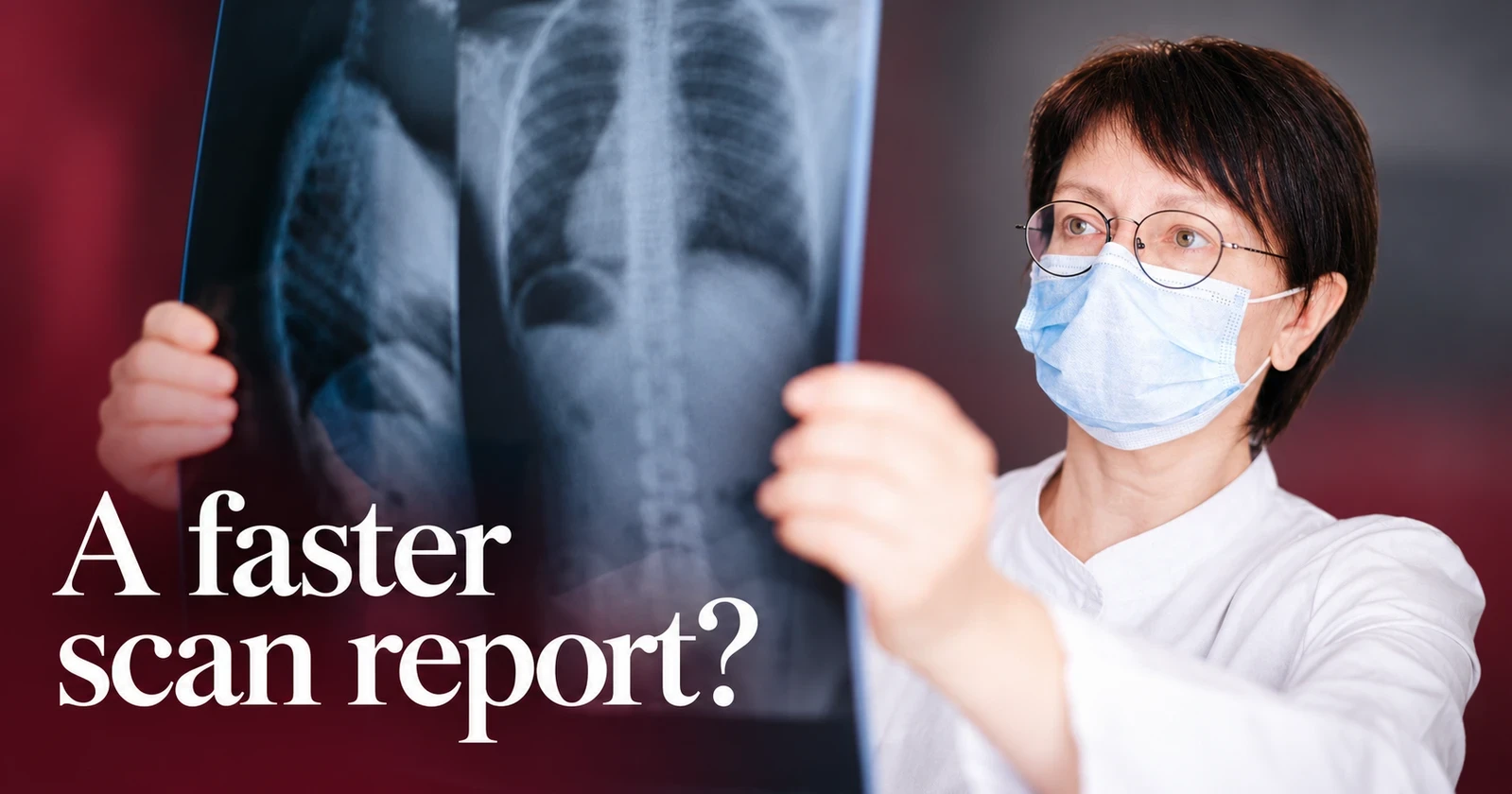
AI can move a suspicious chest X-ray towards the front of a reporting queue without establishing that patients receive an earlier diagnosis or better treatment. An NHS implementation evaluation found modest, variable timing improvements and little evidence of staff time saved. Its findings support a more specific question than whether chest-imaging AI “works”: which part of the pathway changed?
The NIHR Rapid Service Evaluation Team’s phase 2 work examined implementation, experience, impact and costs. Its in-depth work covered ten NHS trusts within a wider national programme. The participating services and their use of AI differed, making local context central to the interpretation. Evaluation summary
Prioritisation changes the queue, not the whole pathway
The evaluation team’s published interview describes AI analysing images for possible abnormalities and helping prioritise them for human readers. All the hospitals they examined used it to support clinical decision-making. That is a different service from one issuing a final autonomous report. How the tools were used
Following a suspected abnormality through the service exposes several separate outcomes:
- Prioritisation: whether the image is moved ahead for review.
- Reporting: when a clinician completes and returns the interpretation.
- Investigation: whether and when further assessment happens.
- Patient outcome: whether care changes in a way that improves health.
A gain at the first stage does not supply the result at the fourth. Each stage needs a measure matched to its actual purpose. This is particularly important when a product demonstration shows rapid analysis but the service’s problem is a later appointment or investigation bottleneck.
A before-and-after improvement needs a comparator
The evaluation found shorter overall turnaround times after deployment. However, the change in reports completed within 24 hours was not significant after accounting for changes at non-AI sites. That matters: a change observed during adoption cannot automatically be assigned entirely to the software. Impact findings
Follow-up referrals and time from chest X-ray to CT also varied across services. These are useful findings precisely because they show that installing a tool and changing a care pathway are different interventions. They do not establish a universal timing benefit or demonstrate that the tool had no value anywhere.
Integration and monitoring are part of the cost
The March 2026 report identifies project management and IT integration as major implementation resources. Ongoing monitoring and maintenance also required work, while evidence of staff time-saving under the operational arrangements was limited. Its cost-effectiveness findings rested on negligible estimated incremental health benefits. Costs and resource findings
That is a reason to retain the size of the estimated benefit beside a favourable cost-effectiveness conclusion. It is not a basis for saying the evaluation demonstrated large health gains or freed a predictable number of radiologists’ hours.
The distinction resembles the one in our AI-scribe analysis: time on one task and time across the working day are separate outcomes. Here, faster image handling and a shorter diagnostic pathway likewise need separate evidence.
What the evaluation leaves unresolved
The researchers identify limited control data, difficulties separating AI from other changes, retrospective cost collection and gaps in onward-investigation and patient-outcome information. Their patient interviews also represented a small sample. The study could not establish long-term effects on outcomes such as cancer stage or mortality. Strengths and limitations
For a service team, the practical contribution is a map of what to measure: the queue, reporting, follow-up, staff work and outcomes, with the local workflow described. A prioritisation tool can then be assessed against the problem it is actually meant to solve.