

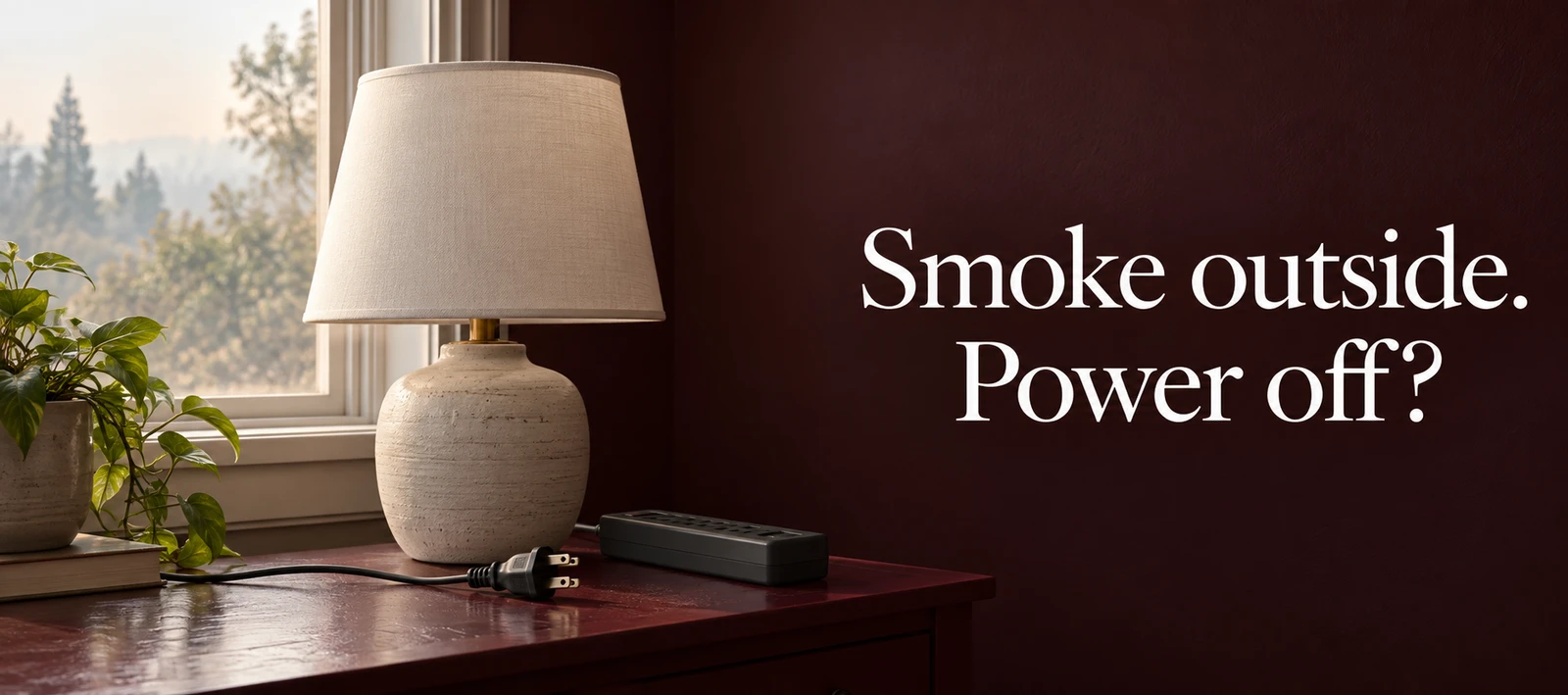
Severe planned power shutoffs in California were associated with higher odds of same-day respiratory emergency visits or unplanned hospital admission, according to a new study of adults’ care records from 2013–2019. The association was larger when shutoffs coincided with wildfire smoke. The results concern a combined acute-care outcome, rather than a count of people whose medical equipment failed at home. Original PLOS Medicine study
For home and community care, the study raises a practical systems question: what happens when losing electricity overlaps with another environmental hazard? Its findings help frame that question, but they do not identify a safe outage duration or calculate the net benefit of an individual shutoff decision.
A planned shutoff has a different purpose from an accidental outage
California utilities can temporarily de-energize power lines to reduce the risk of fires caused by electrical infrastructure. The programme is known as Public Safety Power Shutoffs, or PSPS. The California Public Utilities Commission describes shutoffs as a measure of last resort and acknowledges that leaving communities and essential facilities without power creates its own risks and hardships. CPUC programme explanation
That is the setting the researchers examined. They did not pool all outages into one exposure. Their study focused on planned PSPS events, alongside estimates of the fine-particle pollution specifically attributable to wildfire smoke.
A measure introduced to reduce one hazard can therefore overlap with another hazard even when the underlying purpose is protective. Whether a particular shutoff prevented a fire is a separate question from whether respiratory care use was elevated on exposed days.
The study compares short-term exposure conditions
The researchers linked electricity-utility records and estimated wildfire PM2.5 concentrations to residential zip codes. They examined emergency department visits and unscheduled hospital admissions among adults aged 20 and over in California from 2013–2019.
The time-stratified case-crossover design compared an encounter day with matched days in the same month, year and day of the week, using the person’s residential area. This helps control factors that remain stable for that person over the comparison period. Models also adjusted for daily temperature. It does not remove every possible short-term difference between days. Methods
The primary outage-magnitude measure used the number of customers without electricity. “Severe” therefore describes a study exposure category based on affected customer counts; it is not simply a synonym for the longest outage or an individual household’s experience.
Read the odds ratio with its outcome and comparison
Severe shutoffs without wildfire smoke were associated with an odds ratio of 1.06 for a same-day respiratory emergency visit or unplanned admission, with a 95% confidence interval of 1.02–1.11.
For a severe shutoff occurring alongside 10 micrograms per cubic metre higher wildfire PM2.5, the estimated joint odds ratio was 1.16, with a 95% confidence interval of 1.10–1.22, compared with no shutoff and no wildfire PM2.5 exposure. The study also found evidence of an interaction on the multiplicative scale. Main results and Figure 3
These are estimated odds for the defined encounter outcome under the model’s exposure comparisons. They are not percentage-point increases in the chance that every exposed resident will need hospital care. The joint estimate should not be detached from the smoke increment, outage category or baseline comparison.
The respiratory associations were stronger for COPD-related encounters. Cardiovascular and psychiatric encounter analyses did not show the same association. That does not establish that an outage has no cardiovascular or psychological consequences: the outcomes capture people reaching acute care, not every symptom or difficulty experienced at home.
The records cannot tell the whole household story
Exposure was assigned using the residential zip code, rather than a direct record of each person’s electricity supply, location or indoor air. Someone might have left home during a shutoff. The study could not measure whether an individual oxygen concentrator, ventilation device or air cleaner stopped working.
The outcome also combines emergency visits and unscheduled admissions. It cannot separate all the different decisions and circumstances that lead to those forms of care, and it does not include people who never reached a hospital or deaths outside hospital. The historical study period does not automatically describe the effects of today’s programme. Discussion and limitations
The paper reports public research funding and an author’s separate resilience-hub work and paid expert-witness role relating to outage reporting. Those disclosures are available with the original article.
The contribution is a population-level respiratory-care signal around two overlapping exposures. It supports examining electricity continuity and environmental conditions together, while leaving individual device planning, present-day service performance and the overall costs and benefits of a shutoff to the evidence needed for those separate decisions.