

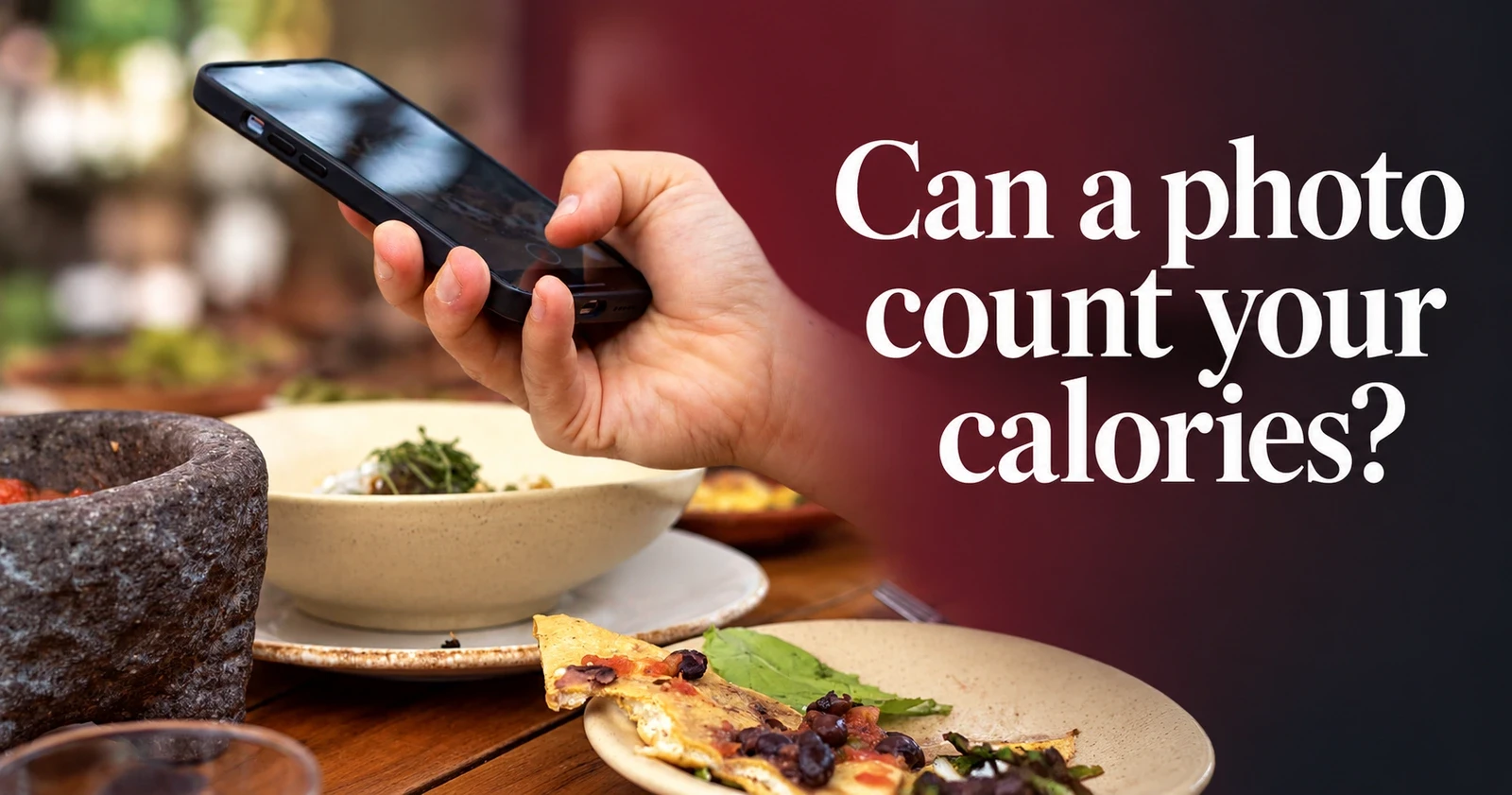
A food-photo app can recognize what is on a plate and still get its energy content wrong. Naming the food, estimating the portion and assigning a nutritional value are separate tasks. A convincing label on the screen does not establish that all three were completed accurately.
This is the most useful distinction in the evidence on photographic calorie estimates. It makes room for helpful food-recognition tools without treating every displayed calorie figure as a measurement.
The path from picture to number
An image-based estimate needs to connect visible information to a food entry, an amount and a nutrient calculation. Each stage can introduce uncertainty. A mixed dish is particularly revealing: identifying some ingredients is not the same as knowing its full recipe or the quantities used.
In a 2024 Australian app evaluation, researchers tested AI-enabled image recognition using 22 food and drink images. They assessed recognition across seven apps and automatic energy output across four. Strong food-identification results did not establish accurate automatic energy estimates.
The study recorded specific app versions. Its researchers were trained in nutrition and dietetics, and the test used controlled images and food-record reference methods. Those conditions matter when applying its findings to a person photographing meals in everyday life. They also prevent an older comparison becoming a current product ranking.
One example makes the distinction concrete. In that evaluation, MyFitnessPal version 24.10.0 recognized 38 of 39 food components across the test images, or 97%. Yet for the study’s eggs-on-toast-with-butter image, its energy estimate was 35% below the reference, with butter omitted. The recognition percentage and the meal’s energy error measure different things; neither is a performance estimate for the current app. Study Tables 8 and 10
A result can be right at one stage
An app’s food label and its calorie output should therefore be judged as two different results. Correctly recognizing a dish narrows the problem, but does not resolve every ingredient or portion question.
This also changes how an accuracy claim should be read. The useful question is “accuracy of what?” A percentage for recognizing food components does not automatically describe portion-size accuracy, calorie error or completeness of a full day’s record.
Those distinctions are more informative than placing all image-based tools on a single good-or-bad scale. They identify the part of a task for which a result actually provides evidence.
Research tools and everyday apps are not one category
A 2025 scoping review examines a wider range of AI-assisted dietary assessment, including image systems and wearables across different populations and settings. It reports promising applications as well as inconsistent performance and practical difficulties.
That variety is important counterevidence to the idea that photographic assessment simply cannot work. Some approaches are designed for constrained settings or use additional information. Results from those systems cannot automatically be transferred to a general-purpose consumer app—or used to dismiss all such apps.
The review also describes challenges around recording snacks, recipes and taking photographs in social settings. These concern whether the record captures what was eaten, not just the accuracy of an algorithm presented with a selected picture.
What would make a comparison useful?
A useful evaluation would identify the tested software version, foods and population; explain how the reference energy values were obtained; separate recognition from portion and energy error; and show whether users could correct mistakes. It would also distinguish a meal estimate from a complete dietary record.
These are questions about evidence, not a league table of products. The studies discussed here do not establish the best app in 2026 or show that a particular photo feature produces weight loss.
The number on the screen is the end of a sequence of estimates. Understanding that sequence reveals what a food photo contributes—and what still needs to be supplied or checked before the number can mean what the reader thinks it means.